Monday, June 11, 2018

The Future of Central America

March 2018

The Future of Central America

This past month, I had the great opportunity to visit Central America with my colleague Lisa Coen of Avenue Strategies. We had great dialogue with leaders from El Salvador, Guatemala, Honduras and Nicaragua. Businesses in these countries are providing unique services and products to the United States and offer integral trade partnerships for US companies. The discussion of trade issues and domestic legislation that will affect Central America is of great interest in the region and should be an important focus for us in the United States, as these partnerships are crucial to our global economy.
 
EL DIARIO DE HOY
(El Salvador)


Expertos impulsan negociación por posibles cambios al CAFTA


READ ARTICLE
EL HERALDO
(Honduras)


Expertos Avizoran Que Vendra
Revision al CAFTA


READ ARTICLE
Entrevistas CDNN 23
con Plinio Suarez Garcia

(Nicaragua)


Visita a Centroamérica de estrategas político

WATCH INTERVIEW
Copyright © 2018 The Estopinan Group, All rights reserved.

The Hill: When rebuilding Puerto Rico, let's start with its economy, by Art Estopinan


When it rains it pours. It seems these days, Puerto Rico can't catch a break. As the people of the island work to recover from a double whammy of devastating storms, must, as a nation, take a closer look at assisting our fellow American citizens through economic development and disaster relief for Puerto Rico.
Already in a perilous economic situation, Puerto Rico now must grapple with the urgent matters such as roadway cleanup and hooking people back up to clean, running water and the electrical grid.

As Congress works on emergency appropriations legislation for those affected by Hurricanes Harvey, Irma and Maria in Texas, Florida and the U.S. territories of Puerto Rico and the Virgin Islands, two key members of Congress can play a vital role in our rebuilding efforts. Both are Florida Republicans. The first is Sen. Marco Rubio who serves a large number of Puerto Ricans living in his home state of Florida and is a member of the Senate Appropriations Committee. The second is Rep. Mario Diaz-Balart of Miami, a longtime advocate for Puerto Rico and a member of the House Appropriations Committee. Their leadership in Congress to help Floridians and Puerto Ricans rebuild from these horrible hurricanes is crucial.

Another good example of proactive efforts that are currently taking place in Congress to help Puerto Rico is that of Resident Commissioner Jennifer Gonzalez-Colon who introduced a bill to amend Title 49 referencing air cargo on the Island. The “Puerto Rico Air Cargo Industry Empowerment Act,” or HR 3472. This bill is introduced in connection to an economic growth strategy modifying the federal laws that currently governs cargo transported in any aircraft on the island of Puerto Rico. Given their current economic situation, passing laws like this one will provides necessary changes to integrate shifts that can benefit the development and growth of the island.

While strategizing options for development of the economy in Puerto Rico, we must take into consideration that the household income of 3.4 million Puerto Rican citizens reflects nearly $20,000 per year. By contrast, on the mainland, Mississippi has the lowest income per capita and the household income is nearly $40,000 per year with a similar population of almost 3 million citizens. There is a significant gap to fill in transitioning Puerto Rico out of a third world country status and out of their $72 billion debt.

There are several important and viable industries in Puerto Rico that help the economy greatly. Tourism is one of the most predominate sources of income, in which their economy is highly dependent on thanks to their beautiful beaches and sunshine. The other one is manufacturing which produces 49 percent of employment on the island and most are good paying jobs. However, there is great potential to increase those primary industries on the island to others, such as: aviation, international banking, international finance, medical tourism, fashion and arts, transportation infrastructure, energy and information technology just to name a few sectors.

For sustainable economic growth, investors in Puerto Rico should maintain a long-term perspective and create business opportunities that will address the ongoing need for economic growth and development. Legislative efforts including changes to Title 49 will help. This sets in motion the upward domino effect for increased employment and higher wages ultimately increasing the household income and the overall economy on the island. The implementation of the new industries and needed reforms in established sectors such as energy, are essential to improve the economy where tourism, manufacturing and other  promising sectors can flourish for the residents of Puerto Rico and all Americans.

Art Estopinan is part of the New World Group, which represents the Coalition of the Private Sector in Puerto Rico. Estopinan is a contributor to the American Project with the School of Public Policy at Pepperdine University in Malibu, California. 


Copyright © 2017 The Estopinan Group, All rights reserved.
You are receiving this email because you are connected with Art Estopinan.

Our mailing address is:
The Estopinan Group


Want to change how you receive these emails?
You can update your preferences or unsubscribe from this list.

Email Marketing Powered by MailChimp

The Washington Times: Building a Stronger Economy by Art Estopinan


ANALYSIS/OPINION:
The infrastructure in China is impressive. My recent visit extremely impacted my perspective on the overall transportation systems in the United States as I witness that China has a big advantage with their wonderful airports, road systems and with their unique Shanghai Maglev Train. I had the opportunity to ride on the world’s fastest commercial train; it has maintained its record since 2004.

The train can speed up to 268 mph and can quickly travel 19 miles in a short 7.5 minutes. This strategy saves valuable time and achieves results that are more cost effective. We in America must satisfy society and provide transportation methods that reflect the rapid developments of the 21st century. Time is of the essence and we know that fast turnaround ultimately closes the deal efficiently and effectively. It was instructive to experience firsthand how a quicker transportation system adds a lot of value to commerce — and for traveling passengers as well. We need an innovative system to compete with other leading countries around the world.

Private and public partnerships in transportation are key components for government to obtain effective results. Partnerships will create leverage for private sector entities to financially develop our economy by integrating resources and also creating jobs. The overall improvement of the U.S. infrastructure, particularly state and local transit, can be made possible by partnering with public entities such as non-profits to implement immediate results.

A source of revenue such as tolls or other public revenue is required to pay back private investments, and the outcomes are likely to be extremely rewarding. Our global economy thrives on time-saving innovations. The quicker transport of goods inevitably leads to increased productivity. By initiating and implementing new structures in transportation a significant value would be added to our nation’s infrastructure.

Private and public partnerships share a vision to regain our global leadership in transportation such as the one we had in aviation for so long. The country at large needs better trains and roadway systems. We must also effectively secure our bridges to help transport people and products in a timely fashion.

Intrastate commerce will also increase with an improved infrastructure system. Our leaders should support President Trump’s infrastructure plans for economic development with American labor, energy, iron and steel industries. Nurturing existing private and public partnerships as well as establishing new partnerships is fundamental. Funding is being allocated to complete current projects and to begin future projects on much needed improved roads, bridges, tunnels, highways and airports.

Meanwhile, the Trump administration is working on accounting for federal taxpayer dollars to ensure the progress of infrastructure projects. Prioritizing local and state needs is a pressing concern now since there are multiple action items lined up to address the nation’s infrastructure problems. Last night, at a dinner with Mr. Trump and a group of bipartisan U. S. senators including Sen. Joe Manchin, West Virginia Democrat. Mr. Manchin has publicly pressed for U.S. infrastructure buildup and was front and center in their discussion.

President Trump is working in a proactive way to address many of his priorities, and infrastructure buildup must be a bipartisan effort as it is a winning issue for America, not simply a Republican or Democratic initiative.

As Trump recently stated, new building projects inspire Americans, and introducing new technology to our daily transportation needs will elevate our global standing into the 21st century. The Chinese are grateful for their commercial train system, and soon we will be able to compete with their efficiency. At the same time, producing new projects would create jobs and wealth in the U.S. The president and Congress must come together to address the urgency of prioritizing and executing actions immediately. I am certain our global economy will flourish significantly once we are able to transport passengers and goods efficiently throughout the entire nation.

• Art Estopinan, president of The Estopinan Group, is a contributor to the American Project, School of Public Policy, at Pepperdine University.

Copyright © 2017 The Washington Times, LLC.


Copyright © 2017 The Estopinan Group, All rights reserved.
You are receiving this email because you are an active contact for Art Estopinan.

Our mailing address is:
The Estopinan Group


Want to change how you receive these emails?
You can update your preferences or unsubscribe from this list.

Tuesday, June 5, 2018

Politico Influence: Avenue Strategies Adds Estopinan

POLITICO INFLUENCE: 

AVENUE ADDS FORMER ROS-LEHTINEN CHIEF OF STAFF: Avenue Strategies Global, one of the lobbying firms started by Corey Lewandowskiand Barry Bennett, is adding Art Estopinan as a partner. Estopinan, a former chief of staff to Rep. Ileana Ros-Lehtinen (R-Fla.), will help Avenue lobby for Qatar, which is paying Avenue $500,000 a month as it tries to win friends in Washington as its diplomatic standoff with Saudi Arabia and its allies enters the fifth month. "Right now it's just the Qatar project, but my guess is we'll be fully integrating him into the firm," Bennett said in an interview.
- Avenue Strategies Global is the sister firm to Avenue Strategies, which Lewandowski and Bennett started after the election. Lewandowski quit in May, and two other Avenue lobbyists, Jason Osborne and Mike Rubino, left over the summer. Estopinan will continue to run his own firm, the Estopinan Group, where he represents clients including the Washington Strategy Group, an outfit run by supporters of the Fethullah Gülen, the cleric the Turkish government blames for a failed coup last year.
 
By Theodoric Meyer | 10/04/2017 02:32 PM EDT
With David Beavers and Aubree Eliza Weaver


The lobbyist of lobbyists in Washington, D.C.


Central America faces different dilemmas that could affect the economic and political stability of the region and in which collaboration or involvement by the government of the United States could have a positive effect in the search for a solution.  The countries of the northern triangle (Guatemala, El Salvador and Honduras) struggle against serious internal insecurity that could increase, in case the Trump administration decides to deport gang members, as he had already announced during his campaign.

"One of the priorities for Central America is a national security of the Central American countries. “The reality is that, in my personal opinion, the United States must help Central American countries bring those individuals to justice in their countries of origin. The deportation of immigrants with criminal backgrounds could mean instability for the Central American region and the United States must help to guarantee the security in those countries. We can help with these initiatives,” asserts Arturo ‘Art’ Estopiñán, who worked as chief of staff for the chair emeritus of the Foreign Affairs Committee, Ileana Ros- Lehtienen, and who has 27 years of experience in the U.S. Congress.

In the specific case of Nicaragua, the Nicaraguan Investment Conditionality Act (also known as the Nica Act), could bring devastating effects to the country, since its actual wording would have adverse economic ramifications and would create a negative economic environment for investment in that country. “As banker and entrepreneur, this legislation is very worrisome for Nicaragua,” asserts Robert J. Argüello, president of the consulting firm CEO Advisors, which hired Estopiñán’s firm, The Estopiñán Group, to lobby and stop the Nica Act as it was written, “Because it would harm Nicaragua enormously and would have serious consequences for the population.” Also, sending millions of Central Americans back to their country of origin with an uncertain immigration status is also worrisome for the region. During his campaign, Trump said he would kick out 11 million undocumented immigrants.

Open Fronts
In general, all the Central American countries would be affected with other common problems, including the renegotiation of the Central American Free Trade Agreement between Central America and the United States (Cafta). With that in mind, and with the changing political atmosphere in Washington, and because of the policies that the Trump administration wants to pass, there could be a highly negative impact in the region.

Estopiñán asserts that any approach to the U.S. government must be made in a proactive manner, with those who can guide the Trump administration on what are their priorities, to reach a win-win relationship with Central America, using advisors who know well how the White House, Congress, and the political system of the country work.  ‘Unfortunately, there are many interests and issues that this administration has to deal with, and it won’t necessarily focus on Central America.  We have to show (to the Trump administration) the opportunities that exist so that Central America and the United States can both benefit from them. I think that if the Central American governments offered opportunities where both regions would benefits, maybe different economic initiatives where they invited U.S. companies to make all kinds of economic investments, mutually beneficially, that would be something that would be welcomed by the Trump administration”, says Estopiñán.

Under Cafta, Central America exported $4.818 billion to the United States, according to the Secretariat of Central American Economic Integration, says the Monitor of Central American commerce in its 2016 second trimester edition, which represents 33.36% of the total $14.441 billion of all Central American exports. Estopiñán figures that all of the trade agreements are going to be reviewed, which puts the region in a vulnerable position. “When and how, it’s not known for sure. But I do believe that all the trade agreements are going to be looked at and maybe changed. Trump wants to start with Nafta and with our economic relationship with China, because he believes that both countries have an unfair advantage over the United States. After that, he’s going to look at the other trade agreements to see what needs to be changed. It’s important that the countries which have trade agreements with the United States look at them and have a plan. There’s no need to wait until the administration says what needs to change, without being prepared to have your own initiative and adapt those plans to a new administration with a proactive proposal”, he says.

Extensive Experience
Congressman Dan Burton, chairman of the Western Hemisphere congressional subcommittee, has a long history and knowledge of legislative matters. Burton, who is now in the private sector, is up to speed on all the projects and issues related to Latin America and can help with that in Arturo ‘Art’ Estopiñán To work in the Capitol of the United States, which is undoubtedly one of the most powerful legislative bodies of the world, has opened for me an enormous perspective to get to know other countries, other cultures, as well as how the Congress of the United States, the White House, and the executive branch work in general. It’s a very important process, that not too many people know, how bills go through the process, how the executive branch works. There is a whole series of complex bureaucracies, but with my years of experience, I’ve had the opportunity to see firsthand how this all this legislative, administrative, and White House, works. Number two, I have had the opportunity to have contacts all over the world, because of the various congressional trips that I went on with my colleagues and other chiefs of staff around the world.  It was an unique opportunity, because I still maintain some of those relationships, with diplomatic and political leaders, in Asia, Europe, Latin America, and the Middle East, in particular.” NMG Trends the new Trump administration and Republican Congress. “Now, with Congressman Burton, we’ve formed an alliance to help companies, associations, or individuals from Latin America who would like guidance and advice in the nation’s capital, Washington, D.C. We have the experience, the contacts, and a proven winning record”, assures Estopiñán.

From Difficulty Comes Opportunity
According to the expert, what looks to be short-term problems for the Central American governments presents a series of opportunities of growth for the region. For Estopiñán, “Yes there are opportunities for economic growth, but one understands that it’s not free, that it’s through trade agreements.

According to the specialist on congressional affairs, there are key opportunities, if and when these directly benefit the United States and Central American nations.

Central America has an impressive population of young people and important natural resources, two aspects that, unfortunately, previous administrations (in the United States) did not know how to deal with well. If this administration takes an interest, not only in helping Central America -- because we have to work together as neighbors– but also in establishing mutually beneficial relations, it would be very positive for both sides, because if Central America establishes itself politically, from that political stability comes an economic growth that will result in more funds for Central America to buy products from the United States.

By Arturo Castro Barrantes

Arturo ‘Art’ Estopiñán
To work in the Capitol of the United States, which is undoubtedly one of the most powerful legislative bodies of the world, has opened for me an enormous perspective to get to know other countries, other cultures, as well as how the Congress of the United States, the White House, and the executive branch work in general.  It’s a very important process, that not too many people know, how bills go through the process, how the executive branch works. There is a whole series of complex bureaucracies, but with my years of experience, I’ve had the opportunity to see firsthand how this all this legislative, administrative, and White House, works. Number two, I have had the opportunity to have contacts all over the world, because of the various congressional trips that I went on with my colleagues and other chiefs of staff around the world.  It was an unique opportunity, because I still maintain some of those relationships,
with diplomatic and political leaders, in Asia, Europe, Latin America, and the Middle East, in particular.”

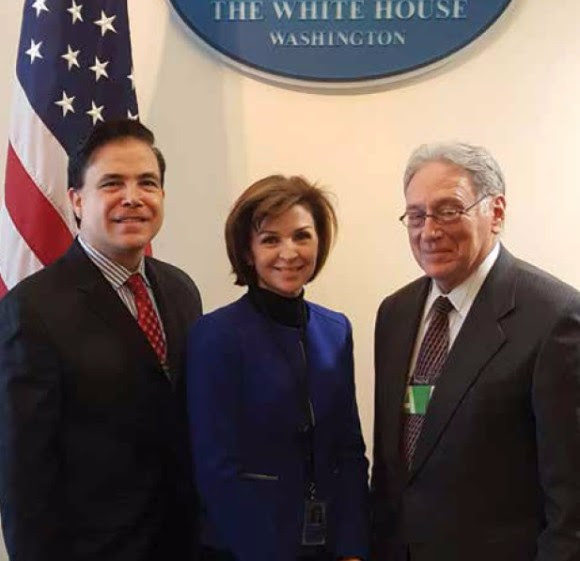
White House Director of Media, Helen Aguirre Ferre and David Miller, P.A.

In the U.S. Senatae with Florida Senator Marco Rubio
With his wife Olga Estopinan and Congresswoman Ileana Ros-Lehtinen


Monday, October 2, 2017

Rare diseases and the U.S. commitment to life


ANALYSIS/OPINION:
Socialized medicine would bring the U.S. a lot closer to total socialism. Doctors, medical service and hospital facilities would be solely administered by government, state agencies or other organized groups. Funding would be obtained by philanthropists, assessments or even worse — taxation. Imposed government taxes would create a government bidding system for medical services and supplies — increasing costs.
The existing relationships between doctors and patients would shift and the logistical requirements for specialized treatments would also disrupt privacy. The review approving medical attention for the “problems of the sick” would become public instead of honoring the decisions of immediate family.
The Independent Payment Advisory Board (IPAB) provision under Obamacare is completely independent to you and your doctors; the physician who knows your case, evaluates, diagnoses and treats you for your medical conditions. This board is independent to your hospital and Medicare — also independent of Congress, the judiciary, the democratic process, ultimately even the Constitution.
It consists of 15 unelected bureaucrats confirmed by the Senate. IPAB submits recommendations to Congress to prevent a high growth of national health care expenditures — essentially micromanaging our health care into rules outside our control.
There are many who strongly reject the “Death Panel” such as the American Medical Association. Many do not agree with the board’s authority and inflexible mandate to impose arbitrary across-the-board cuts to physicians and other providers.
Shifting this dynamic could adversely affect access to health care services for those with rare diseases and Medicare patients as well. Many potential consumers do not attend their regular visits, making matters worse, conditions become acute and more expensive to treat. The working class should choose their health insurance based on their needs in a free market with competition for affordable health care benefits for themselves and their children.
We can see a clear example of socialized medicine given the current health system in the United Kingdom with the case of Charlie Gard. Charlie had a disease called Mitochondrial DNA Depletion Syndrome which affects cells that provide energy to muscles, kidneys and the brain. His muscles began to become weak rather quickly, yet he was never brain dead.
Great Ormond Street Hospital had the power to take Charlie’s parents to court and request permission to remove the machines and technology necessary to keep Charlie alive. His parents researched and found hope with seven different experts. One of those experts is Dr. Micho Hirano from Columbia University Medical Center (CUMC) in New York City. Dr. Hirano is a clinical expert of neuromuscular rare diseases; he is also the doctor who treats my son “Arturito.”
Arturito is one of 16 patients in the world who are currently being treated for a similar muscular depletion with experimental medication. After administering these experimental medications for my son for nearly four years, and tracking numerous milestones of improvements I am extremely grateful for the opportunity of this treatment.
As a parent advocate with major strides of progress, I visited Charlie Gard’s family in London with my testament and encouraged them to believe in the opportunity and possibility of a cure provided by Dr. Hirano. In the U.S., despite the statistics and potential negative predictions, the health care system does not interfere with my personal decisions and respect our family’s privacy: I am always entitled to pursue my parental rights and so are the other 15 parent who choose to give their child a chance of life.
Charlie’s parents, Connie Yates and Chris Gard, conducted extensive fundraising efforts and have received contributions from over 83,096 individuals/entities to help fund their wish to try experimental medication to save Charlie’s life. They took matters into their own hands with their GoFundMe page, created a website plus extensive advocating on social media to overcome the challenges caused by the limited funding accessible from their socialized medical system.
This system (equivalent to our IPAB) removed parental rights, forbidding these parents their own child’s best interest. Take a moment to interpret these emotions as a parent to a young child — or — toward your elderly parents.
On July 28, 2017 — just one week before his first birthday — Charlie Gard passed away due to the lack of the experimental medications which could have saved his life. States should pursue patient-centered, market based reforms that get health care back on track. We need a market-based competitive health care system to sustain reasonable and affordable plans for everyone regardless of their illnesses. We must respect the privacy and the will of loved-ones.
Essentially, from this example, we understand that rare diseases don’t get enough funding for research — but why should that be a reason for a child to die? We’re the United States of America — and here the power of choice is freedom.